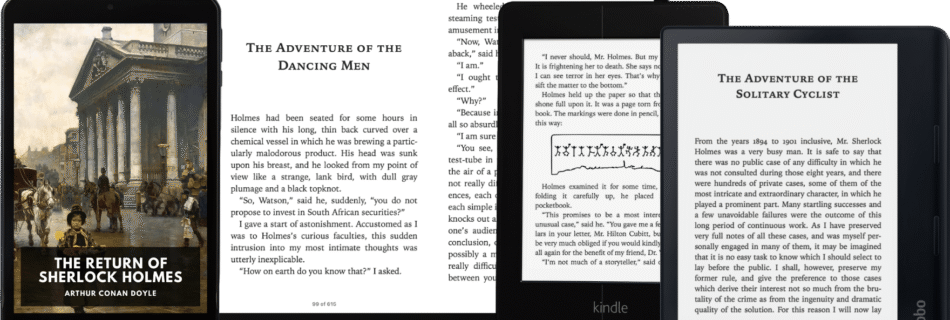

Devices for Consuming Books

Reading in the Digital Age The way we enjoy books has changed dramatically over the past few decades. While reading was once exclusively associated with printed pages, technological advances now offer multiple ways to access novels, essays, academic publications, and audiobooks from virtually anywhere. The digital revolution has not replaced traditional books, but it has …


Audiobooks for Everyone: Technology in the Service of Inclusion

Technology has profoundly transformed the way we access culture, education, and entertainment. Among the most significant innovations of recent years, audiobooks have emerged as a powerful tool for bringing reading to millions of people. Today, thanks to advances in artificial intelligence, voice synthesis, and digital platforms, audiobooks are playing a key role in building a …

Synthetic Voices vs. Human Narrators: Competition or Collaboration?

The rise of Artificial Intelligence in audiobook production has sparked intense debate across the publishing industry. Are we witnessing a threat to professional narrators, or the emergence of a powerful tool that will expand creative and commercial opportunities? As with most technological revolutions, the answer is more nuanced than a simple choice between humans and …

The Introduction of Artificial Intelligence in Audiobook Production

A Revolution Transforming the Industry The audiobook industry is experiencing one of the most significant transformations in its history. The arrival of Artificial Intelligence (AI) is not only changing how audio content is produced, but also democratizing access to the format, reducing costs, and accelerating processes that, until recently, required weeks or even months of …

The Book Market in Argentina

Adaptation, Transformation, and Opportunities in a Key Cultural Industry Despite technological change, recurring economic crises, and evolving patterns of cultural consumption, Argentina’s publishing industry remains one of the most significant in Latin America. Its strength is rooted not only in a rich literary and academic tradition, but also in the ability of publishers, bookstores, distributors, …

The future of authorship

How the identity of the creator will evolve in a hybrid world where humans, communities, platforms and AI systems coexist Authorship is entering a new stage. For centuries it was understood as an individual, intimate and almost artisanal act. Today, in an ecosystem where creation is distributed across people, technologies and communities, authorship becomes broader, …

Authorship in the age of collaboration

How the identity of the creator changes when works are built through multiple voices, technologies and communities Authorship is no longer a solitary act. In the digital era, creation has become a collaborative, distributed and often hybrid process. Works that once emerged from a single voice are now shaped by authors, editors, readers, platforms, algorithms …

The legal architecture of copyright

The structural framework that supports creation, intellectual property and the circulation of knowledge in the contemporary ecosystem Copyright is not just a set of rules: it is a legal architecture designed to protect creativity, regulate the exploitation of works and balance the interests of authors, publishers, platforms and society. This architecture defines how a right …

EPUB 3.3

The version that stabilizes the standard and sets a long‑term foundation for professional digital publishing EPUB 3.3 marks a decisive shift in the evolution of the ebook format. It is not a feature‑driven release; it is a stability‑driven release. Its purpose is to give publishers, distributors and reading systems a clearer, more predictable and more …

What is the EPUB format, really?

The digital standard that structures, organizes and enables professional ebook production Although we often refer to EPUB as “the ebook format,” it is much more than that: it is a publishing standard, a structured container and an organizational system that allows a digital book to be accessible, navigable, adaptable and compatible across platforms. Understanding EPUB …

The future of ebooks

A rapidly evolving digital ecosystem reshaping how publishers design, distribute and scale their catalogues The future of ebooks is no longer defined by the device or the file format. It is shaped by a broader digital ecosystem where production workflows, metadata structures, accessibility standards, platform interoperability and reader behavior converge. For publishers, the ebook is …

Moldova’s literary market

A small but efficient ecosystem for catalogue expansion, audience segmentation and editorial development Moldova’s literary market, although small in size, offers a well‑structured environment for publishers looking to expand into Eastern Europe, test content, and refine catalogue strategies. The coexistence of Romanian and Russian means local publishers operate with two distinct catalogue lines, enabling precise …

LIBER 2026

The Fair That Sets the Pulse of the Spanish‑Language Publishing Sector The LIBER 2026 International Book Fair, organized by the Federation of Publishers’ Guilds of Spain, once again establishes itself as the leading professional meeting point for the Spanish‑language publishing ecosystem. Its 2026 edition, held in Barcelona, not only reaffirms its role as a bridge …

Asia’s Book Fairs

The New Strategic Map of the Global Publishing Industry Asia has become one of the most vibrant and strategically important regions for the global publishing industry. With rapidly expanding markets, advanced technological ecosystems, and immense cultural diversity, the continent’s book fairs serve as platforms where rights are negotiated, trends are identified, and international alliances are …

Reading Habits in Young Adults

How They Read, What They Seek, and What It Means for the Publishing Ecosystem Young adults — roughly between 18 and 35 years old — represent one of the most diverse and rapidly evolving reading groups today. Their reading habits are shaped by technology, immediacy, fragmented time, and digital culture. Understanding how they read, what …